

AI in optometry: why clinician expertise remains at the centre of innovation
Executive summary: Specsavers experts, alongside Cascader’s Peter Thomas, discuss how artificial intelligence (AI) can enhance clinical decision-making in optometry. The partnership between Specsavers and Cascader explores how AI can support community optometrists to deliver outstanding patient care, improve pathway efficiency, and strengthen clinical confidence — with clinician expertise firmly at the centre.
Watch / read more: Exploring the integration of AI in practice (Optometry Today / AOP)
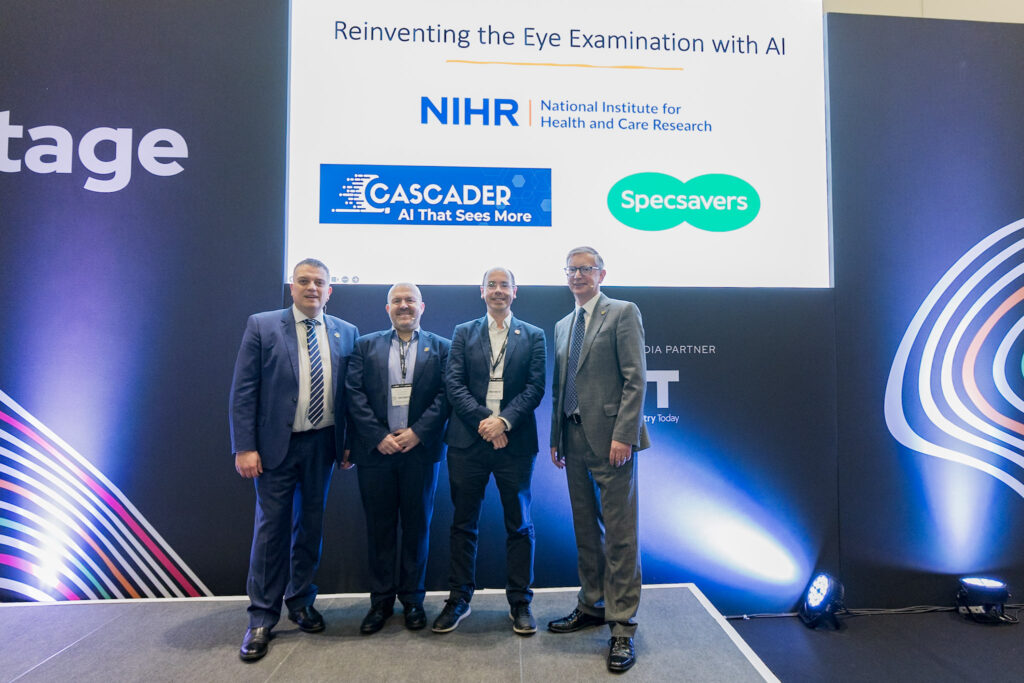
Specsavers-Cascader AI partnership: Paul Morris, Mike Horler, Peter Thomas, Giles Edmonds
Exploring AI in optometry: supporting clinicians, not replacing them
Artificial intelligence (AI) is gaining momentum across healthcare — but in optometry, one principle remains clear: technology must strengthen clinical expertise, not replace it.
According to Optometry Today, discussions at 100% Optical highlighted how AI tools could support clinicians in practice, with a strong emphasis on real-world implementation and clinical relevance.
This was also the focus of a discussion between Giles Edmonds, Clinical Services Director at Specsavers, Paul Morris, Director of Professional Advancement, and Peter Thomas, Chief Executive of AI medical company Cascader.
Together, they explored how AI can support community optometrists to deliver consistent, high-quality care while improving efficiency across patient pathways.
This work forms part of a new partnership between Specsavers and Cascader to explore how AI can be applied responsibly and effectively within community optometry.
Clinician-first AI: experts who care at the centre of decision-making
At the heart of this approach is a simple but critical principle: clinicians remain the decision-makers.
Giles Edmonds, Clinical Services Director at Specsavers, says: ‘AI has huge potential to support clinicians — not replace them. It can provide additional insight and analysis, but responsibility and clinical judgement always sit with the clinician.’
This clinician-first approach reflects Specsavers’ commitment to ‘experts who care’ — ensuring innovation enhances professional expertise while maintaining trust, accountability, and patient-centred care.
Designing AI tools that work in real-world optometry practice
For AI to succeed in optical practice, it must be grounded in real-world clinical environments.
Collaboration between clinicians, industry experts and technology partners is essential to ensure tools are not only innovative, but practical and relevant.
Paul Morris, Director of Professional Advancement, says: ‘Innovation only succeeds if it works in practice. Collaboration ensures AI tools are clinically meaningful, usable, and genuinely helpful to optometrists.’
This focus ensures that technology supports the realities of busy community practices — helping clinicians make confident, informed decisions while maintaining efficiency.
Exploring the integration of AI in practice
According to Optometry Today coverage of 100% Optical, a key focus for the profession is bridging the gap between technological capability and practical application. Ensuring AI integrates seamlessly into existing workflows is critical to delivering meaningful benefits for both clinicians and patients.
How AI can support patient care and clinical pathways
AI-assisted tools have the potential to enhance multiple aspects of patient care in optometry, including:
- Earlier identification of eye conditions through enhanced analysis and data support
- Greater consistency in clinical decision-making across practitioners and practices
- More appropriate referrals into secondary care, supporting system-wide efficiency
- Improved patient outcomes through timely and accurate clinical insights
By supporting — rather than replacing — clinician judgement, AI can help ensure patients receive the right care, at the right time.
Building trust in AI innovation across the eye health sector
Introducing AI into clinical settings requires trust — from clinicians, patients, and the wider healthcare system.
This trust is built through:
- Clinical evidence and validation
- Transparent collaboration with experts
- A clear focus on patient benefit
- Maintaining clinician accountability
Through its partnership with Cascader, Specsavers is committed to ensuring AI innovation is both clinically credible and practically useful — supporting community optometrists to continue delivering outstanding care.
Learn more about AI in optometry and the Specsavers partnership
👉 Groundbreaking AI partnership with Specsavers and Cascader
Reviewed by Giles Edmonds, Clinical Services Director, Specsavers